When music meets Arduino


A beautiful project by [Leigh Davis]. It is a brilliant proof of how Arduino fits into virtually any sphere of thought and is the shortest path for a creator realizing his idea in reality.
He writes:
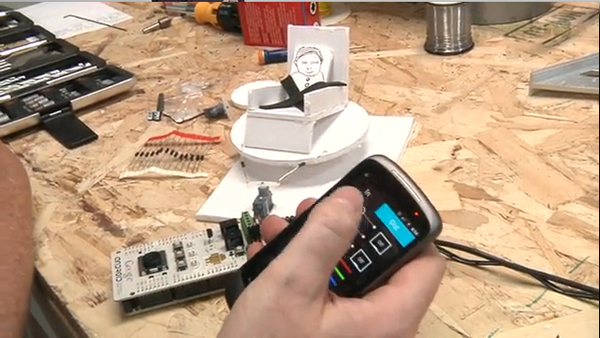
I began the first few days by developing a stand alone application build in MaxMSP that understands the notes that a play on my (recently purchased second-hand) flute. I set the range from low C right up to the 3rd octave D. Each note of the chromatic scale triggers a bang, which is coloured uniquely to the other notes bang messages.
The bang message then sets the corresponding color to the display screen on the application. Which will in turn send a signal to the arduino to dispense the corresponding oil color on water according to the different notes. (Something like a physical Milkdrop!)He further plans to control different LEDs, motors and the likes using the Rayne application.


Read more »
These icons link to social bookmarking sites where readers can share and discover new web pages.
  • Digg
  • Sphinn
  • del.icio.us
  • Facebook
  • Mixx
  • Google
  • Furl
  • Reddit
  • Spurl
  • StumbleUpon
  • Technorati

Arduino DashBoard App


[Jonathan Clark] from Lousiville Hackerspace has developed an application that is constantly checking the state of I/O pin of your Arduino board, updating a window on your desktop.
ArduinoDashboard is an application for viewing analog and digital pin sensor values from an arduino in real time. This can be used with any arduino sketch and now has compiled versions with no need to download processing.org ide. Sources included as well.
via [HackADay] [Adafruit] source [lvl1.org]


Read more »
These icons link to social bookmarking sites where readers can share and discover new web pages.
  • Digg
  • Sphinn
  • del.icio.us
  • Facebook
  • Mixx
  • Google
  • Furl
  • Reddit
  • Spurl
  • StumbleUpon
  • Technorati


I’m happy to announce that the Arduino family is now bigger: Priya Kuber (twitter,site) is going to help us out on our blogging queue as well as managing several internal projects. She is living in New Dehli, and has fallen in love for electronics & tinkering at the age of 12 in her fathers’ workshop at home. She is also the co-founder of9circuits, one of our indian distributor.
Young, yet well experienced, she is familiar with coding and in dealing with online communities.
Above all, I am challenged to share the Arduino Blog with a woman (in a man-oriented world like electronics is) from India (one of the most relevant coutries in terms of electronics and components supply).
Stay tuned for new, upcoming surprises!

Read more »
These icons link to social bookmarking sites where readers can share and discover new web pages.
  • Digg
  • Sphinn
  • del.icio.us
  • Facebook
  • Mixx
  • Google
  • Furl
  • Reddit
  • Spurl
  • StumbleUpon
  • Technorati

The Ben Heck Show, the DIY format on Revision3, explains and uses the Android Development Kit.

On this weeks The Ben Heck Show, Ben jumps right in to using the Android Accessory Development Kit and gets started on building a Baby Rocker that simulates vehicle motion from logged Android sensor data.

It’s amazing to see different efforts in building detailed instructions in using the board and the way this Arduino-to-Android device is changing the design for apps and physical interfaces. For more info check our ADK LABs page.

via [Make] [r/Android] source [tbhs/r3]

Read more »
These icons link to social bookmarking sites where readers can share and discover new web pages.
  • Digg
  • Sphinn
  • del.icio.us
  • Facebook
  • Mixx
  • Google
  • Furl
  • Reddit
  • Spurl
  • StumbleUpon
  • Technorati

[Steve Hoefer] shared an interesting solution for visually impaired people.

It measures the distance to things and translates that into pressure on the wrist.[...] It’s wrist mounted and senses objects from about 1 inch (2 cm) to 10 feet (3.5m). It has generally fast response time (fractions of a second) to quickly navigate complex environments.

It’s not the first time we see Arduino used for custom solutions to navigate a room and / or enviroment, replacing the sight (above all, you’ll remember the [Bat Googles] project from USI and [Halo], the winner project of Humana competition).

“Tacit”, that’s how’s called this cool project, is the first in moving the sensitive response area of the device from the head (closed to the ears) to wrists (closed to the hands). Steve, whom its first prototype was conceived has an headband like the two projects above, moved its device to the wrist for several reasons

The headband was a great first test, and it did work, but it had two fatal flaws:

1) The most dangerous obstacles are not at head level. Furniture and most of the other things that can be tripped over and stubbed on are waist level or lower.

2) Vibrating motors stuck on your skull will drive you insane quickly.

In addition it would be a challenge to disguise it as anything but some mad-science-looking headband, and blind people do care how they look.

Tacit is wonderfully referenced and it’s realeased in CC-NC-SA

via [Grathio Labs]

Read more »
These icons link to social bookmarking sites where readers can share and discover new web pages.
  • Digg
  • Sphinn
  • del.icio.us
  • Facebook
  • Mixx
  • Google
  • Furl
  • Reddit
  • Spurl
  • StumbleUpon
  • Technorati


Matt Richardson has a great blog post on Make about using an Arduino to read the closed-captioning stream from a TV using a video experimenters shield, then muting the TV whenever the name of an annoying celebrity is heard. Besides being a great idea, it’s a nicely made explanatory video. Nice work, Matt!


Matt Richardson's TV muter project. Image from makezine.com
Read more »
These icons link to social bookmarking sites where readers can share and discover new web pages.
  • Digg
  • Sphinn
  • del.icio.us
  • Facebook
  • Mixx
  • Google
  • Furl
  • Reddit
  • Spurl
  • StumbleUpon
  • Technorati

time print machine from Paul Ferragut on Vimeo.

[Paul Ferragout] realized a strange printer, with an incorporated program to print any image using a time-based algorithm. According to the grey value of a pixel on an image, the felt pen remains in contact with the blotting paper for relative periods of time.

The Arduino-controlled Time Print Machine uses an algorithm to “paint” images — portraits, still lives, you name it — out of nothing but splotches of ink. Equipped with a felt pen and blotting paper, it works like a CNC-milling machine. Program the machine to render a digital image, and the pen starts stabbing at the paper, varying the amount of time it spends on each dot according to the gray value of the respective pixel; the more time allotted, the more the ink bleeds, and the thicker the dot.

The resulting images can take up to 34 hours to print and look like bad photocopies, each totally unique. We’re not sure whether to think of the Time Print Machine as the world’s least-efficient printer or the world’s most-efficient Pointillist painter. The one thing we know is this: The machine is weirdly hypnotic. We could watch that thing drop ink all afternoon

via [FastCoDesign] source [Paul Ferrabout]

Read more »
These icons link to social bookmarking sites where readers can share and discover new web pages.
  • Digg
  • Sphinn
  • del.icio.us
  • Facebook
  • Mixx
  • Google
  • Furl
  • Reddit
  • Spurl
  • StumbleUpon
  • Technorati

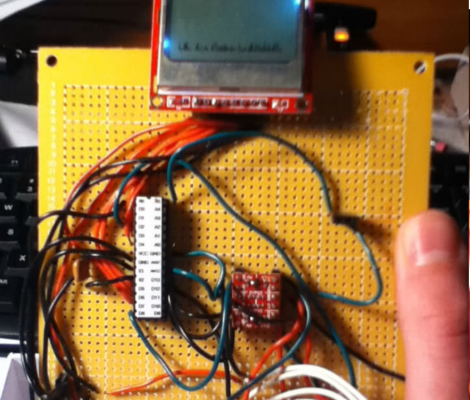
Arduino forum user [Blibo] shares its 2.4 Ghz spectrum analyzer project on theforum. The project is based on the CYWM6935 board (wireless), an Atmega 328 and a Nokia 5110 LCD-

I finished the (mostly) permanent version of my 2.4ghz spectrum analyzer, and soldered it up. I included 3 modes for scanning (fast, slow, and ghost – like the long exposure on a camera), plus a function to display the voltage on an analog pin, and graph it (for when the oscilloscope’s not cooperating). These modes are toggled through by hitting the big push button [...] I have already used it to help setup my wireless network, (channel, location, things that cause interference), and it is always interesting to see what uses the 2.4ghz spectrum. So far, the things that I’ve noticed on the spectrum while walking around with the analyzer are:
-microwave ovens (huge disturbance in the middle of the spectrum)
-Wifi
-Cordless phones
-Bluetooth
-Wireless keyboard
-Wireless speakers
The fast mode is ok for seeing EMI, but for digital signals, the slow mode is best. The ghost mode also gives a general idea of spectrum use over a period of time.

via [HackADay] source(code) on [Arduino Forum]

Read more »
These icons link to social bookmarking sites where readers can share and discover new web pages.
  • Digg
  • Sphinn
  • del.icio.us
  • Facebook
  • Mixx
  • Google
  • Furl
  • Reddit
  • Spurl
  • StumbleUpon
  • Technorati

If your office suffers of ”conference room abuse” you should build your own “roominator” to coordinate it:

Conference Room Abuse is where people 2 or more people randomly grab a conference without any regard to the schedule for the room. Its a problem many companies face.

[Rapleaf] tried to solve this by creating a system to coordinate the (mis)use of room conferences

The hardware consists of two parts: a display unit that’s posted outside of each conference room, and a controller unit that’s located in Rapleaf’s wiring closet. The display unit shows the current and upcoming reservations and an LED status indicator that can tell you from a distance whether a room is “good to grab”. It also has a pair of buttons – one to make an ad-hoc reservation and one to cancel the current reservation. The controller unit interfaces with all the displays to distribute power and data, both of which run over a single standard Cat5e cable. Both the controller and the displays are Arduino-based.

The software component is a Rails web site that allows for configuration and integrates with Google Calendar. Reservations made via Google Calendar are sync’d with the Roominator, and vice-versa. The controller unit polls the web site for the information it should pass to the displays.

Rapleaf open sourced the code on github, with all the instructions for the set up.

via [Kinlane] source [Rapleaf]

Read more »
These icons link to social bookmarking sites where readers can share and discover new web pages.
  • Digg
  • Sphinn
  • del.icio.us
  • Facebook
  • Mixx
  • Google
  • Furl
  • Reddit
  • Spurl
  • StumbleUpon
  • Technorati

August Specials: Tinkerkit Servos And Open SoftWear

We are happy to announce 3 new products available at the Arduino Store: two powerful servos with the standard Tinkerkit 3pin connector (T010050 andT010051) and OpenSoftwear, a book about fashion and technology by Tony Olsson, David Gaetano, Jonas Odhner, Samson Wiklund, in it’s second, revised edition.
Read more »
These icons link to social bookmarking sites where readers can share and discover new web pages.
  • Digg
  • Sphinn
  • del.icio.us
  • Facebook
  • Mixx
  • Google
  • Furl
  • Reddit
  • Spurl
  • StumbleUpon
  • Technorati

A steam-powered record turntable made out of juck & re-used things.

This was made with small steam engine with a boiler crafted from a copper water pipe and carved some wood for the custom platter and base. Add some magnets, a coil for a pickup and a servo that is controlled by Arduino.

Read more »
These icons link to social bookmarking sites where readers can share and discover new web pages.
  • Digg
  • Sphinn
  • del.icio.us
  • Facebook
  • Mixx
  • Google
  • Furl
  • Reddit
  • Spurl
  • StumbleUpon
  • Technorati

Radio Arduino


Nice Oscar Belle Two Band Transistor Radio (1960s) hacked with Arduino.

What it is really doing is playing 24 music tracks that I preloaded onto an SD card in WAV format. There are also 10 tuning noises tracks that get played when the tuner is turned.

Because this is the first time I did this I had a lot of help. Firstly the chaps and chapesses at Hackspace have been very supportive in teaching me how to use and Arduino, particularly Adrian McEwan and Oomlout. Also Jingle Joe who supervised my soldering of the Wave Shield, Brox who helped me decipher the ancient mysteries of FAT16 and Esme who helped dismantle the original radio… PS I did do some of it myself!

Read more »
These icons link to social bookmarking sites where readers can share and discover new web pages.
  • Digg
  • Sphinn
  • del.icio.us
  • Facebook
  • Mixx
  • Google
  • Furl
  • Reddit
  • Spurl
  • StumbleUpon
  • Technorati